Showing posts with label dogs. Show all posts

Tuesday, December 20, 2016

How to improve animal welfare in Siem Reap with market thinking

Fully aware that I "just" arrived in Cambodia in June 2016, I think it's still worth to share some thoughts and observe rations regarding pets and how to treat them in Cambodia –  mainly dogs since this is my field of passion.

I moved to Cambodia in 200, moved then to Vietnam and lived in Laos and Thailand for three years each. We always had  our two dogs with us, and in Laos the pack grew to four and in Thailand to five dogs. Living in Siem Reap means there is no registered local vet, there is a lot of parvovirus and rabies and other diseases. But there is also hope.

Buntha is quite busy these days since parvo virus is spreading.
I visit frequently Buntha, who studied veterinary medics for a while, but did not graduate. He runs a local vet clinic and serves hundreds of animals a month. The clinic is very basic, not lab, not surgery table (he is not allowed to use anesthesia medicine). People come when the dog is sick, and he does his best. But there is not much of a awareness for the need of prevention, like vaccinations.

So here are my initial conclusions how to improve the welfare of dogs in Siem Reap.

1. Time will heal. My experience in other neighboring countries was that when living conditions change, pet care will follow. People start moving into apartments and taking pets with them. That reduces the risk of infections, but also increases the quality of living conditions because it is a more clean environment. And since a lot of those pets are so called toy dogs which cost a lot, people start caring more about there "investment". So behavior changes, first in the upper middle class, but they are always the first to do.

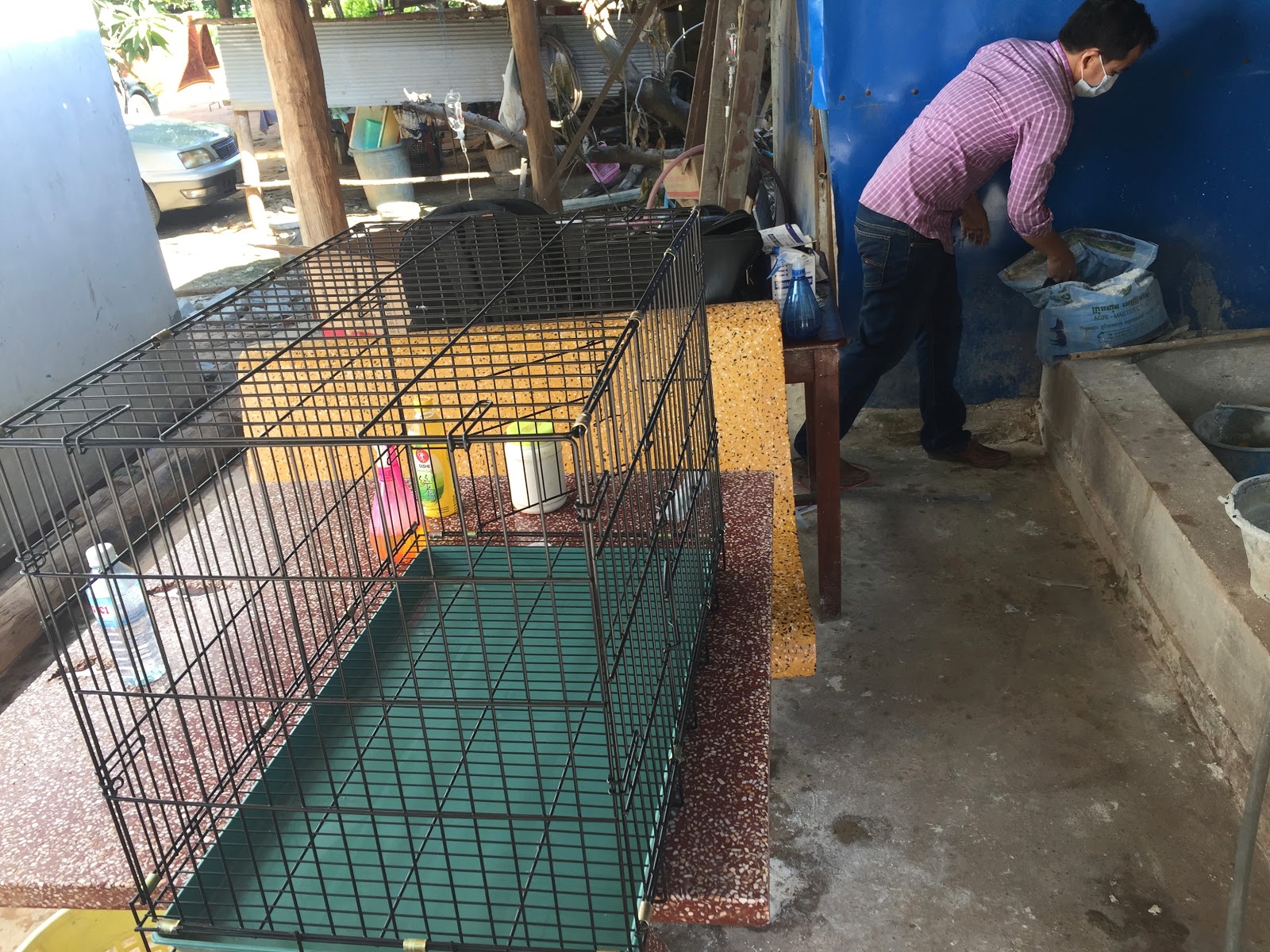
2. Improve and support local initiatives. I donated some cages (and other did too) to Buntha's clinic, so the dogs do not have to share a metal bed where feces and urine is dropping on the concrete floor. There is still a need for a big cage, in case you want to support too. (Leave a comment if you are interested, its about 45 Dollar)

3. On a longer term, Siem Reap needs a local registered vet who runs a clinic as a business. That includes money making services like grooming and even boarding. My friend Analin did this at just without a resident vet in Vientiane. Right now, nobody wants to take the risk of an investment (Angkor Vets did on a small scale). My idea was to give a loan and/or becoming a shareholder if money is an issue, but it still needs the right person. Education in veterinary medicine is of low quality, most students never do a surgery during their studies, and the focus is largely on live stock rather than pet animals. And since Siem Reap is considered province for Phnom Penh students, they like to stay in the city and get a job in bank.

4. There is a need of awareness, but I think it needs to be marketed instead of education. People in general jump on everything that is marketed nicely. So instead of teaching pet owners about viruses, diseases and reproduction, a more business style approach would help more. Make a poster offering 5 percent discount for vaccinations during a certain period. Give discounts for vaccinations of more than two animals. Start issuing a member ship card and collect email addresses so you can send newsletters with new offers. Make brochures with incentives, offer a coupon while explaining why vaccination is important. Give people a card with the five most important signs that the dogs is sick and a emergency phone number. 
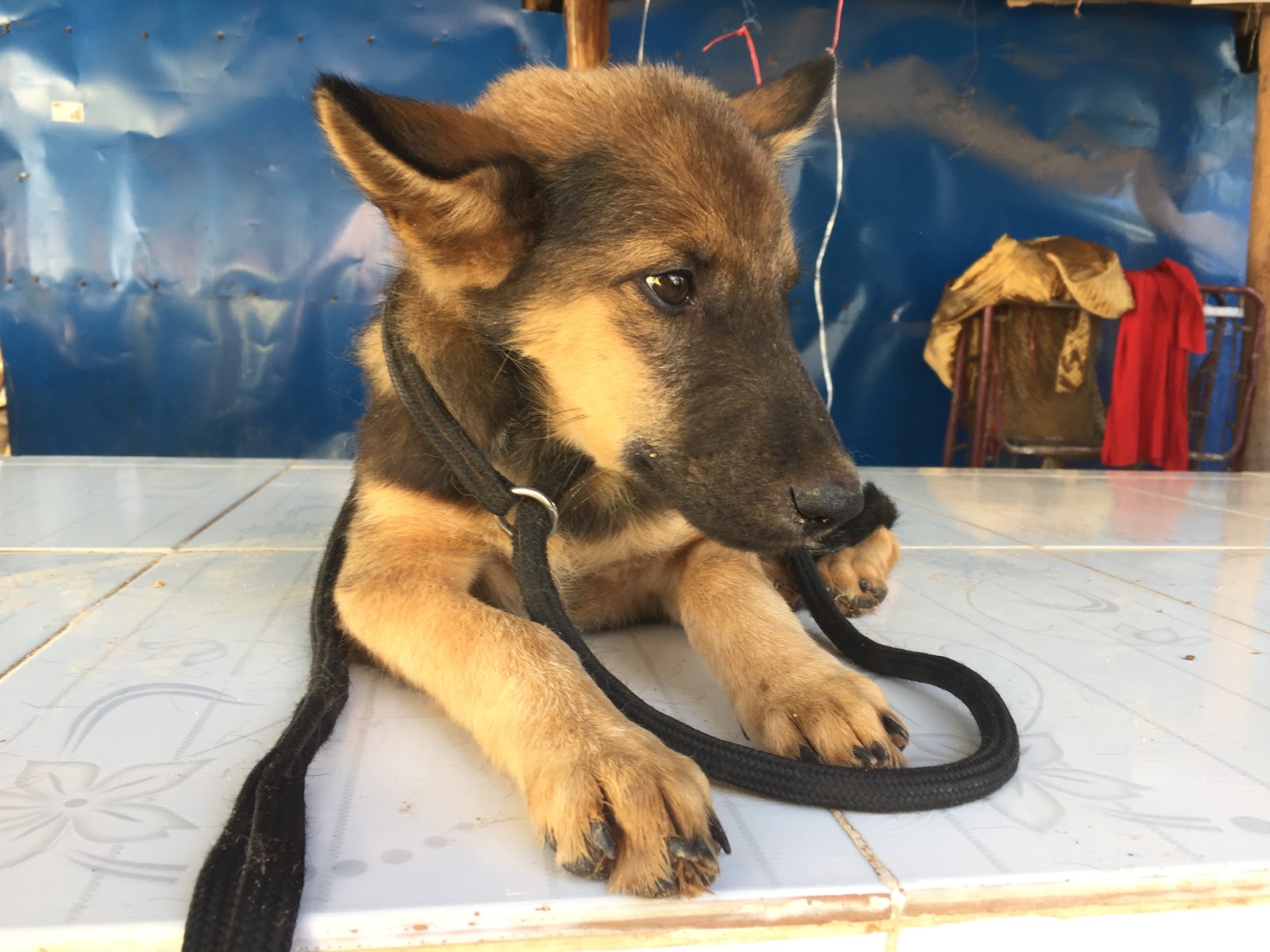
It took 6 days and a 12 Dollar "investment" to save this dog after a parvo infection.
The owners detected it early, called me and I took him to the vet every day.
In exchange, I got water melons and morning glory. 

5. Never give up. I spend some hours at Buntha's clinic with sick dogs from my neighbors I take care of. Since waiting time is about an hour, I could observe a lot. Local Khmer people care a lot about there dogs, that's why they go to the vet. It's only mostly too late. They also pay for treatment, so there is awareness that service isn't free. This  means there is a local market, it just needs better served.

What I will do is soon make a small leaflet in Khmer language to sell vaccinations. Next will be one about spay and neuter. Simple language, few pictures, straight to the point. Not sure about printing costs, maybe I can cover it myself. Als I try to reach out to vets in Phnom Penh figuring out if they would be interested to open a business in Siem Reap.

I do not think that visiting vets or nurses will make a change. It might help short term as the World Vets and the GeoVets did, but I strongly believe this is a local issue and shall and can be solved by Khmer people.

These are my thoughts form observations I made. I may be totally wrong – in this case please tell me why in the comments field. Also, please comment if you just disagree with me, or if you have any suggestions and further information.

Saturday, December 17, 2016

A dogs death and a generous donation

There are days when you don't really know what the meaning of what you experienced was. Today I went to the vet care to get more injections for the neighbors puppy I take care of (he is getting better). When I picked the puppy up at neighbors house a guy approached me asking if I was a doctor. "No,  sorry", I said, "I just bring the dogs to the doctor." He seemed to be very distressed and told me his dog is very sick and the foreign vet is out of town and someone told him to look for me.

Busy day at Bunthas clinic. 
So I told him that I am on the way to the vet care anyway. When I arrived, his dog, a 6 month old Rottweiler, was already there on two drips. The dog had parvovirus and was in a very bad state. The guy said he got the dog from China and was told he was vaccinated - what he was obviously not.

At the same time a young lady came passing by with her bicycle. He stopped, looked at the vet care sign, looked at me and asked me if this was a a vet clinic. I explained her what Ok Hok Sy Veterinary clinic is, told her about the Rottweiler and the threat of parvovirus in Siem Reap and South-East-Asia in general. She was clearly impressed and offered a generous donation for some free vaccinations.

An hour later I came back to the vet just to see how the Rottweiler was doing, but as I feared, he passed away already. His owner was with him all the time, cleaning him, holding him, but the virus had progressed too far.

Another hour later I saw the lady again and she told me she donated 160  USD for vaccines and Bunthas work (yes, she said she wants to pay for his work as well, something I really support).

So, out of the bad news came something good. At least seven dogs will get vaccinated for free soon. But many more need to.

P.S.: I believe that donations help short term, and they are necessary. But long term only behavior change will help, and that means that local people need  to pay for vaccinations. It already starts – as it did in Thailand - with pedigree dogs, because they are expensive. Other dogs will follow, and it will turn into common knowledge. I am working on a small leaflet that explains in simple words why a rabies and parvovirus vaccinations is so important. Stay tuned.

Tuesday, November 29, 2016

You can make a difference for dogs and cats in Siem Reap: Help now!

Today I went to @Ok Hok Sy Veterinary  and delivered three cages. Buntha is very dedicated to help dogs and cats but his resources are limited. After talking with him we figured out that one issue are the metal beds the dogs are laid down. This is better than on the concrete, but still not good. Cages would be a huge improvement. So I just bought three of them.


BUT: HE NEEDS MORE. AND YOU CAN HELP.


You can just buy one (Angkor Vets has them and can order more), or just call me (015879410) me or donate some money so we can buy more. A small cage is 27USD, middle size 34 USD a and big one 45 USD in a good quality. Buntha is located near Spoons restaurant in a small alley behind Wat Damnak.


.
100 Dollar in total would make it possible to get rid of the metal beds.


Wednesday, September 14, 2016

Just go back to your country, where dogs aren't chasing you

There are basically two fractions of expats: Those who compare the current country with their home country and those who are kind of "take it as it is" people. You may find people between those fractions, but start a controversial Facebook post about the garbage problem, and you will see how easily people get divided.

Like the guy who complaint in a Facebook group about dogs chasing him while he was running. That's a common issue in Asia (and Africa and South-America, I assume), and I do understand it might be annoying to runners. If he just would have asked if there are places with less dogs for running, he would have gotten suggestions in seconds. But he took a broader approach, talking about kicking dogs and killing them with his bare hands – the usual troll thing.

Not a dog, and will not bite you. 

I am exploring Siem Reaps outskirts in my bicycle a lot and so far never had issues with dogs. When I see them, I slow down, say hello and that's usually it. I adapt to the environment I am in, and that is the key. If you like running, you most probably developed this hobby back home, in an environment that is safe for runners. Where people keep dogs inside, or on a leash.

50 years ago, before urbanisation and jogging, dogs were roaming the streets in the west as well, or at least they protected the house and the yard and sometimes sneaked out. Jogging and the fitness thing came with the office work and apartments, where people did less physical work. A farmer didn't need to go running after a work day.

And then there is is the natural behavior of dogs chasing everything that is running away from them. Because they can. That's why it is always a good idea to slow down and/or stop and tell them with your body language that you are not a threat but that you are gonna pass by no matter how much they bark.

So, if you start complaining about the fact of roaming dogs (or that many of them carry rabies, what they do), then present a suitable solution. You may find a charity for free rabies vaccination, but you will not change the fact that dogs are allowed to roam the streets. This will change over time, as you can see in Phnom Penh already, when population gets more dense and people start living in condos rather than single houses. (Although Bangkok shows that street dogs still survive, mainly because people feed them well).
This is a dog, but will also not bite you :-)

When you live in another country/continent and maybe soon on another planet, you have to adapt to a certain extend. It doesn't mean you have to throw your garbage around, or burn it. But you have to accept that your neighbors are doing it. You can talk with them, and you may make a change. But other people will still burn it and there is nothing you can do about. Complaining about it is the least helpful approach, and the we westerns vs. those locals thing isn't helpful either.

There are just things you can't do in Cambodia, as there are things you can't do in England or Germany. I miss the snow sometimes, but there is just no snow here. Khmer may want to go fishing at a German river, but they need permission, if they like it or not. We all have to adapt to the environment to a certain extent, whenever we change it. It's like the sweating issue: Most foreigners -  me included – are going crazy when they move to Asia because they are sweating a lot, and it's kind of embarrassing. Until you recognize that locals sweat too, and that it is not a big deal.


Saturday, October 27, 2007

Dog-owners meeting

Its really hard to let your dogs run in Phnom Penh, because there are no parks, and if there are some squaremeters of green dogs are not allowed. So its really helfpul that the owner of the GASOLINA, located oin the 57th street, allows dogowners to bring their pets in every Saturday from 10.30 a.m. on. The dogs can run and play arround while we have breakfast and chatting a lot. Perfectly.