Sunday, November 27, 2022

Voltra Matrix E-Scooter in Cambodia : Review after one year in use

It’s a year now since I bought the Voltra Matrix E-Scooter from a company in Phnom Penh, foreign owned. As you may have seen in previous posts, the promised range-wise wasn’t close to reality. But in general, it’s a good city-scooter. In one year I clocked 3,000 km on this vehicle, and never really ran into any issues apart from the battery. It lasts now 60km with a full charge driving on Set 1 (36-40 km/h). 


It’s seeming to me the performance of the Voltra Matrix is slightly going down: In the first months the first green bar disappeared after 20 km, now is after 18 km. Let’s see how the next year is going. What went down recently was the service in Siem Reap. They refused to do a 3000 km inspection (“no need”), what I would have paid for, of course. Also, after two punctures, they didn’t want to help me buy a new tire (“can have more”). 

No software updates for the Voltra Matrix

The Voltra Matrix uses the same tires as a Honda Today. But I figured out it is not as easy to purchase as I was told when I bought it. The company isn’t strong in communications with customers, and I am still not sure how long they will last. I haven’t seen many models in Siem Reap, and from what I saw in Phnom Penh, most scooters were sold to companies, embassies and alike – I guess mainly for greenwashing reasons. Where electric cars update their software regularly, you won’t see that much in E-scooters. 


The Voltra Matrix is “open design”, as the owner called it, what means it’s a Chinese off-the-shelve-model with a few modifications. They did not develop the software, and I still haven’t figured out who is developing the battery management system. Sources within Voltra told me the BMS at the first model was better, and the battery lasted longer. 

New challenger is coming up: Pople

The market for electric scooters will grow, although it is now dominated by cheap Chinese low-speed vehicles. This will not change until Honda or Yamaha will come up with a proper model (Honda is promising one for a while now). So at least in south-east Asia we have to live with what we have. There is a new player in Cambodia on the market: Pople is renting out scooters and they have a huge charging station. The company behind it, with the obscure name Verywords, told me that they consider putting the white scooters on sale in 2023. I have yet to try them, but the look as good as the Voltra. 

Money saved in a year with my E-Scooter

A Honda Scooby-i consumes 6 liters per 100km, average price is 1.5 USD per liter. So I saved about 270 USD for fuel. Add $ 40 for oil and maintenance I didn’t have to pay for. Charging costs are 12 Riel per kilometer, that would be 9 USD for 3000 km. Initial cost for the Voltra Matrix was 1400 USD. Considering that the battery may decline in the next year and I have to buy a new one ($500), than there is - apart from the lower price for the purchase compared to a $2500 Honda – not much of a saving. But I was told the battery would last up to five years. Let’s see. 

Monday, May 30, 2022

Voltra Matrix E-scooter experience in Cambodia 3rd update

 It's been a while. I am driving the Voltra Matrix now every day. Since I bought it in December 2021 I rode a total of 1980 km on it.  And I still like the riding experience. It has a comfortable seat, the small wheels are great in the city as well as on the few red roads left in Siem Reap. I had no mechanical issue, breaks are good (had a check at 1000 km). 

But: The battery and the range are still disappointing. Yesterday, the battery (and the Voltra Matrix) died after 64 km. I still had a green bar left, but a few minutes later the e-scooter went dark. Again, I had to push it home (not a pleasant experience when it's raining).

One green bar was left.

Minutes later the Voltra Matrix went dark.


I am not sure if the battery display works with the best software, or if it is a calibration issue. But the rule of thumb for me now is: first bar goes off after 20 km, then you have 30 km maximum left, if you want to be on the safe side. That reduces the advertised range by half, from 100 km as promised to actually 50 km. 

This is ok as long as you just charge every two days, so the battery has enough juice. I strongly recommend taking a picture of the km once fully charged. I drive 99 percent on drive 1, only use setting 2 or 3 for overtaking. If I would use it more often, I may have to charge daily. That will also affect the costs – although still less than gasoline.

Since Voltra basically assembled parts and software made by others, I do not expect any updates (I never received an answer about software updates). It seems the eying a energy recovering system for a next generation, but I doubt it is developed in house. They may see what the (Chinese) market offers in terms of quality.

Is the Voltra Matrix 2022 worth buying?

I still think its a good scooter, and for now the best available in Cambodia. If you are fine with the battery limits and count the km left, the its a much better choice than a Honda Scoopy-i or the Zoomer. and of course, its much better for the environment. If you are in Siem Reap or Phnom Penh, you can ask for a test drive at the company's office. Somehow they are still not able to provide a website. 


Friday, March 4, 2022

Voltra Matrix electric scooter in Cambodia – 2nd review

 It's been now 3 months since I bought my Voltra Matrix E-Scooter 2022 edition. There were initial hick ups you can read here about in my first assessment. Now it's time for a review of this e-bike after 1000 km of daily use.


The range

The company selling the Matrix, Voltra, with offices in Phnom Penh and Siem Reap, gives a range of 100 km with a full charged battery. However, this is for people under 70 kg, driving in set 1 (up to 40km/h) and on asphalt. A more realistic range is 60-70 km, which is still reasonable. I charge my battery now every two or three days, when it still has around 30 percent capacity. Talking about capacity: There are only three green and one red bar showing you the current capacity. The first bar disappears after roughly 20 km. The second after an additional 20 to 40 km, depending on the speed and traffic (the more you accelerate, the more power is needed). Once there is only one green bar left I recommend to charge as soon as possible. The manual (yes, there is one now) recommends to not let the battery go to zero.


The driving

Cruising on the new roads in Siem Reap is pure fun. The Matrix is made for an urban environment, and downtown Siem Reap and Phnom Penh are made for them. The seat is extremely comfortable, sitting position is good as well. The brakes are extraordinary compared to those on my Honda Scoopy. I haven't used the electric scooter in rain yet, but I was told a bit of flooding won't be a problem. The owner of Voltra, Yann Vaudin, explained to me at a visit in Phnom Penh how they kept all cables and electric parts away from the bottom. The main controller is actually under the seat. The battery case is sealed. 


The front lights are very bright and great at night. All LEDs have been especially selected for the Matrix, I was told. The Display is great at night, but sometimes hard to read in full sunshine (what is normal, I think).

You need to get used to the driving, in particular when you start on a low speed. As most e-bikes, they start immediately in full power. Driving in Set 1 is ok most of the time, I used the speed 2 and 3 usually for overtaking and long empty stretches. 

The quality

After 1000 km I had only minor issues. A rubber seal under the seat had to be replaced, the stand was adjusted to a better angle, and I use a sticker for the display to avoid scratches. Riding is smooth, the shock absorbers are ok, but when you hit an obstacle or a pothole you feel the plastic casing around the metal frame. 

The software seems to be hard-coded, so I cannot expect optimizations and changes.


Overall conclusion of the Voltra Matrix Electric Scooter

After riding other e-scooters, I think the Voltra Matrix is the closest to an actual scooter and the best you can get in Cambodia. Even if I wished the battery would last longer, it's much more than those electric shopping carts you can see around or the three wheelers. The lithium-ion battery cells are indeed mad by one of the leading Chinese manufacturers, which was just bought by Volkswagen. They should last 1000 full cycles.

Also, there is now a third-party liability insurance offered by Forte for 48 USD per year. 

The selling price includes now the insurance and is $1500 at the time of writing this post. 

Wednesday, December 15, 2021

Going electric in Cambodia: Review of the Voltra Matrix e-Scooter

Everyone can make a difference, and when it comes to climate change, we can do our part. Cutting emissions is one way. We already sold our car, but I thought going electric is the next step. So, I bought a Voltra Matrix e-Scooter. FOR UPDATES, please scroll down.

The Voltra Matrix, the first e-Scooter in Cambodia.


The price tag is $1450, cheaper than a Honda Scoppy-i, but more than most e-Scooters available in Cambodia. The scooters is advertised as "FIRST Cambodian Brand specializing in two-wheeled electric vehicles with a French design that meets High Quality Standards with Superior Guarantees" (Voltra Facebook page). They claim a reach of up to 100km with one battery charge. 

Voltra is a limited company based in Cambodia, run by Yann Vaudin, CEO and Founder of VOLTRA

What I like with the Voltra Matrix 

The design is modern, and different from other e-bikes available in Cambodia right now. It's a proper scooter, and it looks good. Lights are very bright at night, so you can clearly see the street and potholes from far away. The seat is very comfortable to sit. A great asset is the huge space between your feet. It's enough for a 20l water bottle or a box of beer (or two). The speed is remarkable, with setting 3 it's almost too fast. When driving electric bikes, you don't have the reference of the increasing motor sound. 
Great lights

The Voltra Matrix looks good at day and night.


The Voltra Matrix comes with an alarm system. Once it's on, the wheels are blocked and the alarm goes off, when someone touches the scooter. I had a few security guards wondering what they did wrong when they wanted to arrange it.

You have two USB-charging ports, one on the front and one under the seat. Since it's connected to a huge battery, you have a big powerbank with you to charge a phone or connect a loudspeaker. 

E-Scooters don't need a registration in Cambodia (yet), so there is no official ownership card or driver license needed. Hence, you don't have a number plate as well.

The battery life is supposed to be up to 5 years, and a renewal costs $500. That is reasonable compared to maintenance costs of a regular motorbike. Also, with increasing gas prices, electricity is a bit cheaper now. 

When it comes to the environment, you definitely reduce emissions. I couldn't find reports from the actual energy mix in Cambodia in 2021, but from earlier statistics it is mainly imported hydropower., solar and around 30 percent coal. Additionally, there is no need of transporting gasoline on ships to Cambodia and on trucks to the gas station.

You get two disc brakes front and back, what is not yet the standards for regular scooters. 

 A small detail but very useful: It has a rear gear. Good to use when you push back in a crowded parking space or when there are some obstacles.

I was told they partnered up with Forte to offer a third-party liability insurance, but no date has yet announced. But this will be a good, since Forte right now has no clue how to insure an e-scooter.

What I don't like

The Voltra is advertised as a French design, assembled in Cambodia. The owner told me, parts are from different countries. It is, in fact, a Chinese design you can buy from the shelf and add your own parts. Voltra claims to have two years of testing and research done. While the breaking fluid container look fancy, I am concerned the plastic won't last long.

The range is the biggest issue. There is no way you reach 100 km in real life (Setting 1, asphalt, <70kg) . Realistic is 50-60km with lower speed settings (1 and 3, few times 3). I made 75 km when I was using only setting 1, but it was boring, especially on longer stretches, like to the airport. 
Only 53 km with the first charge was disappointing.


Tip: when only one green bar is left, switch to mode 1 and charge the battery once you are home. I barely made 2 km after the charging light started flashing.

I only got an invoice and some spoken introduction, but no manual or anything written down. The company told me a manual is in print, but couldn't (or didn't want) to send me the pdf.

The alarm is quite sensitive. It goes off by the slightest touch, which can be annoying. 

What needs to be improved

I didn't get an answer regarding software updates, and I am uncertain if Voltra actually does software development. It seems they just bought a certain version that comes with the model. That means, there is less likely an optimization or new features.

The side stand has the wrong angle, so it is easy to fall to the right side. Voltra offers a fix, but should do that already before they deliver the scooter.

The communication: I was told "We use the GOTION brand for the lithium cells which equips our battery adding a very powerful BMS for a good management of the charge and discharge of the cells as well as their short cycles. These cells are used for all new electric models from VOLKSWAGEN! "

Gotion is a Chinese battery manufacturer, and Volkswagen recently bought a 26 percent stake. They are planning to produce the new generation of Volkswagen batteries together soon. Since Volkswagen produces cars, it is unlikely the cells are the same. 

Voltra doesn't have a website yet (really!) and the Facebook page is full of promotions (for Angkor Tiger FC), but not many facts and stories about the scooter. 


There is a metal frame underneath, I guess to protect the bottom, and it touches ground easily when the surface is not completely flat. Have to figure out why they build it this way. 

Official Specs

  • The paint is highly resistant to the Cambodian climate (according to the owner)
  • Max Speed 60 km/h
  • Capacity 60V28Ah
  • Battery Type Lithium-Ion
  • Power: 1500 Watt
  • Charging time 5 hours.
  • Motor type: DC brushless
  • Speed settings: 1 <40 km/h, 2 <50 km/h, 3 <60 km/h
  • Controller 12 pipes
  • Weight 85 kg
  • Tires 10x 3.00
  • Seat capacity 2 people
  • Colors: White, black, Grey matte and Black matte
  • Price 41450
  • Energy cost per km: 12 Riel 

Final verdict

The Voltra Matrix is a nice and good scooter for the city and an urban environment. With new roads in Siem Reap now, it is an alternative to a regular motorbike. Other than with a car, you do have to worry about the charge and range. This can be annoying. I think the future is electric, but this model is not yet at a level other companies in Europe, Japan and even China are. I wished there was more done with the software. 

UPDATE 26.12.2021
After complains about the battery performance I received a test battery and finally a new battery. I was told the battery management system had a problem. So I have to test it again on Setting 1. What I recognized is that after a full charge Set 1 goes up to 40km/h hour, until the first battery bar disappears.
Unfortunately the front brake has already a problem and needs to be fixed. The cover for the battery compartment is already contorted – it still fits, but wonder if the battery compartment itself is contorted as well.

UPDATE 31.12.2021
With a new fully charged battery I made it to 80 km now, only driving on Set 1. The front brake is ok now, maybe just a stone between the pads. But the battery management seems to have still problems: The indicator went from one green bar left to 10 seconds of red and then the battery died. I had to push the scooter home again.


Thursday, January 17, 2019

Now you can dine with the locals in Siem Reap and other cities

Yes, it was quiet here for a while, but now I am back. The reason: Together with my co-founder Sorida I am trying to set up a business called Dine With The Locals. The concept: connect travelers with locals through authentic food and experiences.

We are working with Cambodian families in Siem Reap, Battambang, Benteay Meanchey and Phnom Penh (more to come). They prepare a meal, but will also shoe travelers and tourist around. Every place is a special place. We have organic farms, dancers, artist and even crocodiles.


Real local Cambodian food

If you don't know what to eat and you tried nearly every restaurant in Siem Reap, then  Dine With The Locals might be the right thing. It is authentic, so don't expect a fine dining. You may sit on the floor on a matt like all locals, or the dogs and cats will say hello, or just just reach out a bit and grab a mango from the tree. Truly local, no fake, the real experience. And yes, it is safe, because our hosts know how to make proper and healthy food.

If you want to try it, we are happy to provide you any assistance you may need, although booking is quite easy through pur website.

Thursday, April 13, 2017

Puppies in the hood!

These puppies are just a few weeks old. They are not in a pagoda or so called street dogs (I still doubt there are many street dogs in SR). They are the puppies of a pack of dogs that stays with a farmers family in my neighborhood. They do their best, as most people in my neighborhood, to give them food and water. They have no idea about animal welfare (or had, until I moved here), and they have no money to actually pay the doctor. It's a kind of food or doctor fee situation. The chance is high that only 2-3 of the puppies will survive, and that is actually a very natural thing. Only one of the past litter survived, and he is now a healthy dog.

I think it is worth helping people like my neighbors to understand when a dog is sick and to act - and even if this acting is coming to me and ask for help (they also came with a sick cow and a sick duck once). That's a first step. People getting better here over time, and my next campaign will be brochures in Khmer with explanation why vaccination is important. And a map where the vet is and his phone number. My goal is to see my neighbors going to the vet if a dog is sick.


Thursday, March 30, 2017

New Zealand bakery - nothing special

New Zealand bakery is new in town on the riverside road. Staff basic trained, coffee comes in paper cup with plastic lid, food menu is pub food (some say the pies are good) . Music is the usual chart mix, and aircon is full throttle. Coffee is good. Some power outlets but awkward placement. 50 percent discount during opening period. But nothing special to see here. Back to Biolab. #cambodia #coffeeshop #blog — at New Zealand Bakery & Cafe.

Wednesday, March 29, 2017

Those mats are actually beds.


 They are wrapped around a blanket and a pillow, and staff at a gas station (and in many others places here) will then sleep on this bamboo bed. #blog #cambodia

via Instagram http://ift.tt/2o7dApe

Saturday, February 18, 2017

Puppet parade in Siem Reap 2017

The Giant Puppet Project in Siem Reap held its yearly parade yesterday in downtown, starting from the old market through Pub street all the way up to the royal gardens, A lot of schools and NGOs were participating in this. Well done, beautiful giant puppets to see.


Monday, January 23, 2017

The top 5 coffeeshops in Siem Reap

I really like coffee, and I really like to work in a coffeeshop. I always did, even when they were called Cafe. It is the laid back environment what I like, but even when it's crowded I can ignore the noise and just work. Siem Reap is just perfect for my work style, so I thought I make a list of the Top 5 coffeeshops where you can work and where you get great coffee. My benchmark is a) quality of coffee, b) that it's local owned, c) decent internet and d) friendly service. The Top 5 are equally good, but in my opinion stand out compared to others.

BioLab


This coffeeshop opened just a few months ago and quickly gained attention within the freelancer community, both expats and locals. The coffee at Biolab is excellent and very reasonable priced. Internet connection is extremely good and the service is very friendly and helpful. Located at Wat Bo/corner Street 22. Open every day from 7.30 am. Breakfast and a  basic food menu available.

Noir 306


Based a the Hotel 306 at the corner of National Road 6 and Lok Taney Road this little gem opened last year and is one of my favorite places. Internet is decent, coffee is good (what was a surprise since they use Boncafe, normally not my favorite). There are two meeting rooms attached. Sitting at Noir 306 isn't the most comfortable if you are a lounge guy, but the wooden stools force you to sit straight. Lovely stuff and very good and cheap Khmer food. Our business Dine With The Locals was founded in a Noir cafe.

Noir 1928

Another new branch of the same brand. They recently opened Nour 1928 on Road 6 corner Achar Sva street, at the gas station. While it's smaller than the branch at Hotel 306, they offer the sample quality and variety of food and drinks. Decent internet speed and the same friendly stuff. Good location just opposite the Royal Gardens.

Temple Bakery

While I do not like the Temple group too much because of their aggressive strategy to expand and their business behavior in Pub street, the Bakery building at Street 25 is well done. The morning shift is great, service goes down pretty quick in the late afternoon and gets - in particular at the sky deck - horrible at night.
If you like to relax, stretch your legs and but you laptop on a pillow, this is the right place for you. Internet is ok, but drops sometimes. Khmer noodle soup with beef  is only 1.50 between 7-9 am and highly recommended. Staff in the morning shift is quote nice and helpful.

TruBlu

This place is a bit far from downtown, but if you live in the area behind Angkor High School its just perfect for you. Located at Sombai Road/Navutu Road TruBlu recently updated their menu and service, and that was a good thing. Relaxed place, even with beanbags to chill, great food with huge portions, the usual range of coffee and fast internet. Stuff is friendly and helpful.


Runner-Up

Brown Cafe

Finally they came to Sieam Reap, but my favorite Phnom Penh coffeeshop brand screwed up here.  The building is a total architecture failure, because the blank walls and a high ceiling create a constant noise even with a few people there. Service at this Brown branch is sometimes slow and internet drops. While the quality of the coffee is great and food as well (although pricy), the options mentioned above are still better.


Tuesday, January 17, 2017

8 reasons why we should not rescue pagoda dogs and cats

The word of mouth says there are some foreign doctors in town treating pagoda cats and dogs. It was said that no privately owned animals are treated. I think this is a wrong approach. And I tell you why:

1. The reason why dogs and cats have huge litters is because most are supposed to die. That is how it works. Saving them means producing a lot of animals who are unfit for life and reproduction.

2. Let the fittest survive instead of saving the weakest. Locals usually wait a few weeks until they see what cat/dog will survive and keeping it as a pet.

3. By treating pagoda cats and dogs you are actually support the pagoda trade – what means people will continue bringing animals to this place, even if it wasn't meant to be a shelter.

4. Monks accept the animals, but they are a temple, not a animal shelter. Their religious belief  forces them to care but they do it only to still low extent.

5. Rescuing a cat/dog isn't just a one day treatment, but a life long commitment. You don't do that to make you feel good.

6. What is needed is changing habits of locals. You can't do that in a pagoda with foreigners. What is needed is a Khmer owned proper clinic and a Khmer owned proper pet care with dog/cat boarding. Have a look an neighboring countries like Thailand and Laos. The toy dog business (like them or not) made dogs and cats a pet that is accepted in the house - and an investment you care more about. So people start caring about their pets just because their peers do it.

7. Pagodas do not provide medical service. A one day event (beside spay and neuter) doesn't change anything. Money is better spend in supporting/setting up a local clinic with a qualified vet and proper equipment.

8. Siem Reap as any other places in Cambodia needs better equipment and better diagnostic tools for pet care. As long as you can't get blood tested here or an x-ray, those one-day events are useless.


Friday, January 6, 2017

Commute on Yamaha XTZ through outskirts of Siem Reap in Cambodia

My ride from my home to the supermarket on a Yamaha XTZ

Tuesday, December 20, 2016

How to improve animal welfare in Siem Reap with market thinking

Fully aware that I "just" arrived in Cambodia in June 2016, I think it's still worth to share some thoughts and observe rations regarding pets and how to treat them in Cambodia –  mainly dogs since this is my field of passion.

I moved to Cambodia in 200, moved then to Vietnam and lived in Laos and Thailand for three years each. We always had  our two dogs with us, and in Laos the pack grew to four and in Thailand to five dogs. Living in Siem Reap means there is no registered local vet, there is a lot of parvovirus and rabies and other diseases. But there is also hope.

Buntha is quite busy these days since parvo virus is spreading.
I visit frequently Buntha, who studied veterinary medics for a while, but did not graduate. He runs a local vet clinic and serves hundreds of animals a month. The clinic is very basic, not lab, not surgery table (he is not allowed to use anesthesia medicine). People come when the dog is sick, and he does his best. But there is not much of a awareness for the need of prevention, like vaccinations.

So here are my initial conclusions how to improve the welfare of dogs in Siem Reap.

1. Time will heal. My experience in other neighboring countries was that when living conditions change, pet care will follow. People start moving into apartments and taking pets with them. That reduces the risk of infections, but also increases the quality of living conditions because it is a more clean environment. And since a lot of those pets are so called toy dogs which cost a lot, people start caring more about there "investment". So behavior changes, first in the upper middle class, but they are always the first to do.

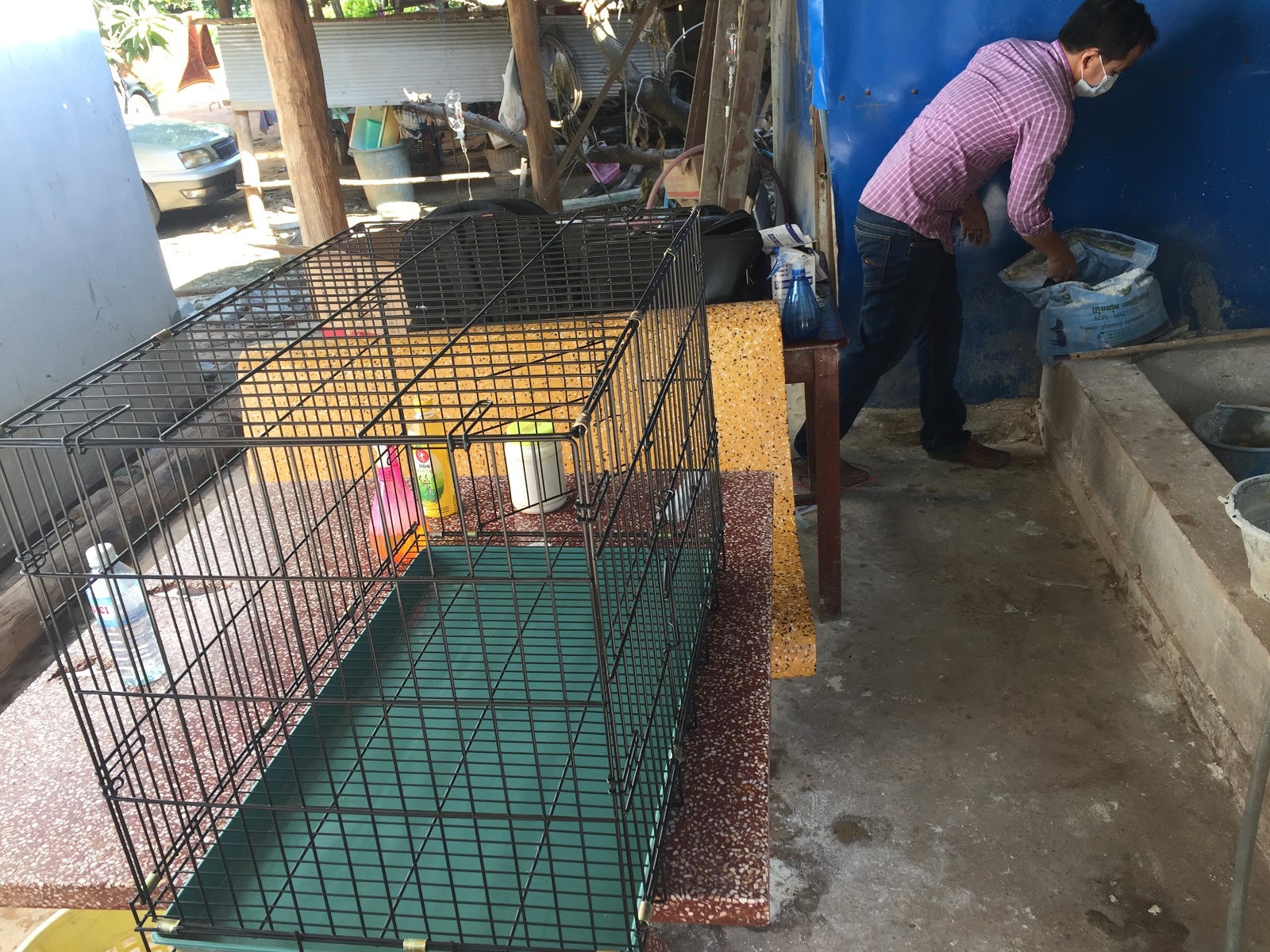
2. Improve and support local initiatives. I donated some cages (and other did too) to Buntha's clinic, so the dogs do not have to share a metal bed where feces and urine is dropping on the concrete floor. There is still a need for a big cage, in case you want to support too. (Leave a comment if you are interested, its about 45 Dollar)

3. On a longer term, Siem Reap needs a local registered vet who runs a clinic as a business. That includes money making services like grooming and even boarding. My friend Analin did this at just without a resident vet in Vientiane. Right now, nobody wants to take the risk of an investment (Angkor Vets did on a small scale). My idea was to give a loan and/or becoming a shareholder if money is an issue, but it still needs the right person. Education in veterinary medicine is of low quality, most students never do a surgery during their studies, and the focus is largely on live stock rather than pet animals. And since Siem Reap is considered province for Phnom Penh students, they like to stay in the city and get a job in bank.

4. There is a need of awareness, but I think it needs to be marketed instead of education. People in general jump on everything that is marketed nicely. So instead of teaching pet owners about viruses, diseases and reproduction, a more business style approach would help more. Make a poster offering 5 percent discount for vaccinations during a certain period. Give discounts for vaccinations of more than two animals. Start issuing a member ship card and collect email addresses so you can send newsletters with new offers. Make brochures with incentives, offer a coupon while explaining why vaccination is important. Give people a card with the five most important signs that the dogs is sick and a emergency phone number. 
It took 6 days and a 12 Dollar "investment" to save this dog after a parvo infection.
The owners detected it early, called me and I took him to the vet every day.
In exchange, I got water melons and morning glory. 

5. Never give up. I spend some hours at Buntha's clinic with sick dogs from my neighbors I take care of. Since waiting time is about an hour, I could observe a lot. Local Khmer people care a lot about there dogs, that's why they go to the vet. It's only mostly too late. They also pay for treatment, so there is awareness that service isn't free. This  means there is a local market, it just needs better served.

What I will do is soon make a small leaflet in Khmer language to sell vaccinations. Next will be one about spay and neuter. Simple language, few pictures, straight to the point. Not sure about printing costs, maybe I can cover it myself. Als I try to reach out to vets in Phnom Penh figuring out if they would be interested to open a business in Siem Reap.

I do not think that visiting vets or nurses will make a change. It might help short term as the World Vets and the GeoVets did, but I strongly believe this is a local issue and shall and can be solved by Khmer people.

These are my thoughts form observations I made. I may be totally wrong – in this case please tell me why in the comments field. Also, please comment if you just disagree with me, or if you have any suggestions and further information.

Saturday, December 17, 2016

A dogs death and a generous donation

There are days when you don't really know what the meaning of what you experienced was. Today I went to the vet care to get more injections for the neighbors puppy I take care of (he is getting better). When I picked the puppy up at neighbors house a guy approached me asking if I was a doctor. "No,  sorry", I said, "I just bring the dogs to the doctor." He seemed to be very distressed and told me his dog is very sick and the foreign vet is out of town and someone told him to look for me.

Busy day at Bunthas clinic. 
So I told him that I am on the way to the vet care anyway. When I arrived, his dog, a 6 month old Rottweiler, was already there on two drips. The dog had parvovirus and was in a very bad state. The guy said he got the dog from China and was told he was vaccinated - what he was obviously not.

At the same time a young lady came passing by with her bicycle. He stopped, looked at the vet care sign, looked at me and asked me if this was a a vet clinic. I explained her what Ok Hok Sy Veterinary clinic is, told her about the Rottweiler and the threat of parvovirus in Siem Reap and South-East-Asia in general. She was clearly impressed and offered a generous donation for some free vaccinations.

An hour later I came back to the vet just to see how the Rottweiler was doing, but as I feared, he passed away already. His owner was with him all the time, cleaning him, holding him, but the virus had progressed too far.

Another hour later I saw the lady again and she told me she donated 160  USD for vaccines and Bunthas work (yes, she said she wants to pay for his work as well, something I really support).

So, out of the bad news came something good. At least seven dogs will get vaccinated for free soon. But many more need to.

P.S.: I believe that donations help short term, and they are necessary. But long term only behavior change will help, and that means that local people need  to pay for vaccinations. It already starts – as it did in Thailand - with pedigree dogs, because they are expensive. Other dogs will follow, and it will turn into common knowledge. I am working on a small leaflet that explains in simple words why a rabies and parvovirus vaccinations is so important. Stay tuned.

Thursday, December 15, 2016

I took Neighbors puppy to the vet again.


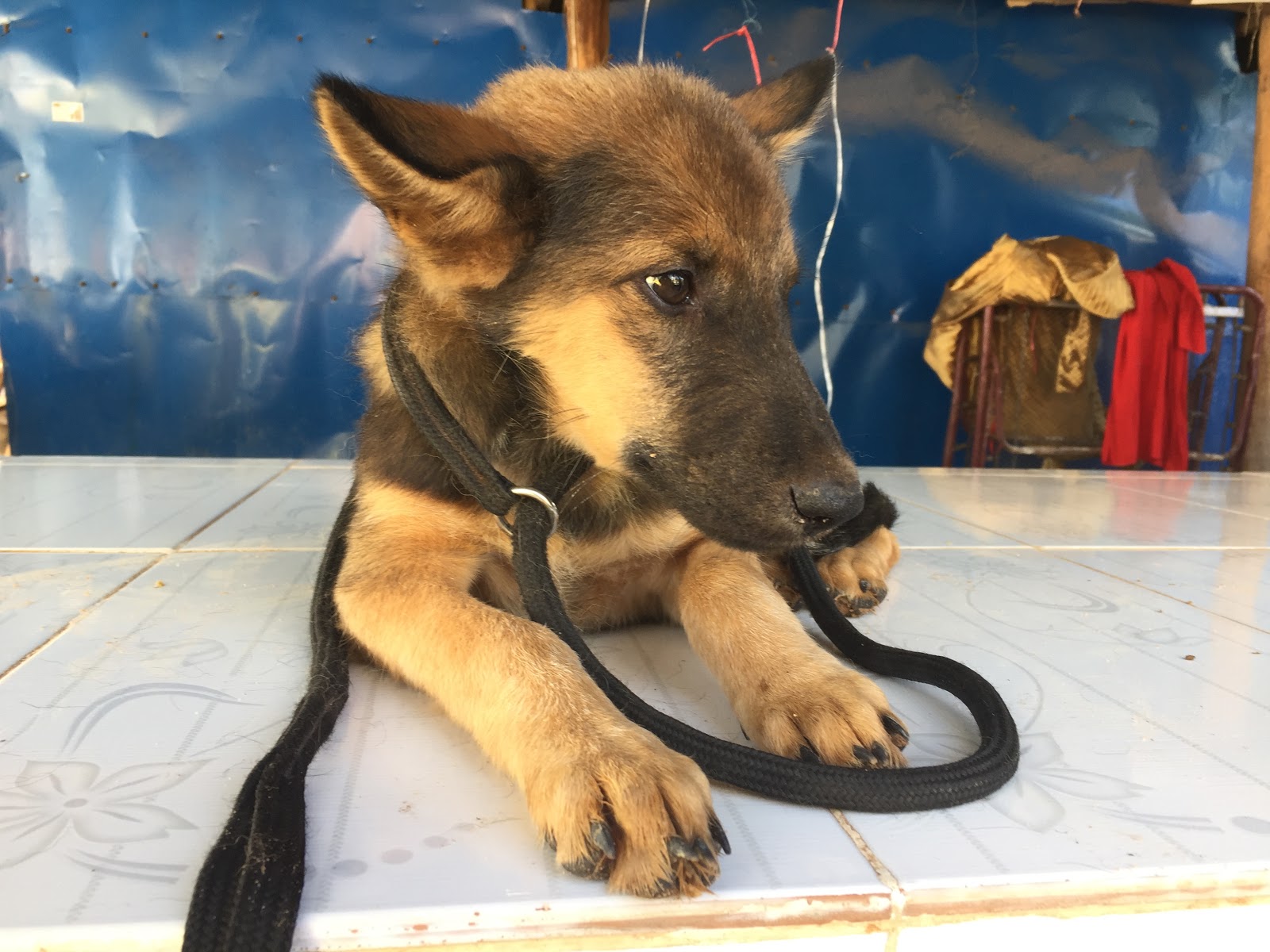
Will get treatment for a week for 2.50 USD a day. Let's hope he will recover. Suspected parvovirus infection. Just learned vaccination will be 12 USD, what is less then the 30USD I was told before. If he survives he will get vaccinated and castrated. #makeachange #blog #khmerdog #streetdog #animals #pets #cambodia #animalrescue #blog
via Instagram http://ift.tt/2hDrb1u

Monday, December 12, 2016

Good morning from Siem Reap.


We see those water buffalos passing by our house every morning. They are quite impressive animals. Out dogs ignore them, they don't even bark when we are next to them. #waterbuffalo #countryside #cambodia #blog
via Instagram http://ift.tt/2hnHxLR

Friday, December 9, 2016

Typical German Christmas cake: Christstollen.


This one is made by baker Alex Kütt in Siem Reap with cashew nuts from Cambodia. There different ways to make this cake, the most famous is the Dresdner Christstollen from Saxonia. #blog #germanfood #christmas #asian
via Instagram http://ift.tt/2h88uVQ

Wednesday, December 7, 2016

Bicycle tour south and north of Siem Reap

Had a lovely ride with my podcast listener Michael from Germany. The tour includes countryside with rice fields, a bit city and the forest. Great half day tour.

Tuesday, November 29, 2016

You can make a difference for dogs and cats in Siem Reap: Help now!

Today I went to @Ok Hok Sy Veterinary  and delivered three cages. Buntha is very dedicated to help dogs and cats but his resources are limited. After talking with him we figured out that one issue are the metal beds the dogs are laid down. This is better than on the concrete, but still not good. Cages would be a huge improvement. So I just bought three of them.


BUT: HE NEEDS MORE. AND YOU CAN HELP.


You can just buy one (Angkor Vets has them and can order more), or just call me (015879410) me or donate some money so we can buy more. A small cage is 27USD, middle size 34 USD a and big one 45 USD in a good quality. Buntha is located near Spoons restaurant in a small alley behind Wat Damnak.


.
100 Dollar in total would make it possible to get rid of the metal beds.